A new paper, available on the arXiv preprint server from researchers at NASA’s Ames Research Center, reports that 73.3% of images the agency’s new SPHEREx space telescope collected between May and September of last year were contaminated by at least one artificial satellite trail. […]
On average, there were 2.18 trails per exposure, most of which are concentrated in an “X” pattern that mimics the orbital paths of the satellite megaconstellations.
There appears to be no easy way to handle this interruption, either. SPHEREx uses an automated “sample up-the-ramp” algorithm to protect itself from stray cosmic rays. When a sudden energy blast from one of those rays hits a pixel, the system halts data collection on that pixel to prevent saturation. But commercial satellites are now so bright that they are triggering this system without the help of any stray cosmic rays.
The resultant images have what the authors describe as “railroad” tracks, where the blinding center of the trail is scrubbed out but parallel lines running alongside it are permanently etched into the science imagery. As a result, the images lose the photometric data of anything hidden beneath the rails.
Examples of the different morphologies of artificial satellite trails in SPHEREx science images. Brighter events tend to display broader trails with low signal residuals in their cores due to the effect of sample up-the-ramp (SUR) algorithm.
Amazon’s satellites, now known as Amazon Leo (formerly Project Kuiper), are brighter than the limits recommended by the International Astronomical Union (IAU). Marginally visible to the naked-eye, their brightness will impact astronomy. The average magnitude for these spacecraft is 6.3, based on 1,938 visual and electronic observations collected by the author. For reference, observers can see 6th-magnitude objects from locations where the sky is minimally affected by light pollution, which is what sets the aesthetic limit. The IAU has a separate recommendation for satellites to avoid impacting research astronomy: For satellites at the Amazon Leo altitude of 630 km (390 miles), that limit is 7.2.
Il paper su cui si basa l’articolo:
The mean apparent magnitude of Amazon Leo satellites is 6.28 based on 1,938 observations. For spacecraft in their operational mode, 92% exceeded the brightness limit recommended by the IAU for interference with research, while 25% distract from aesthetic appreciation of the night sky. The reflective characteristics are similar to Version 1 Starlink spacecraft.
 Il paper: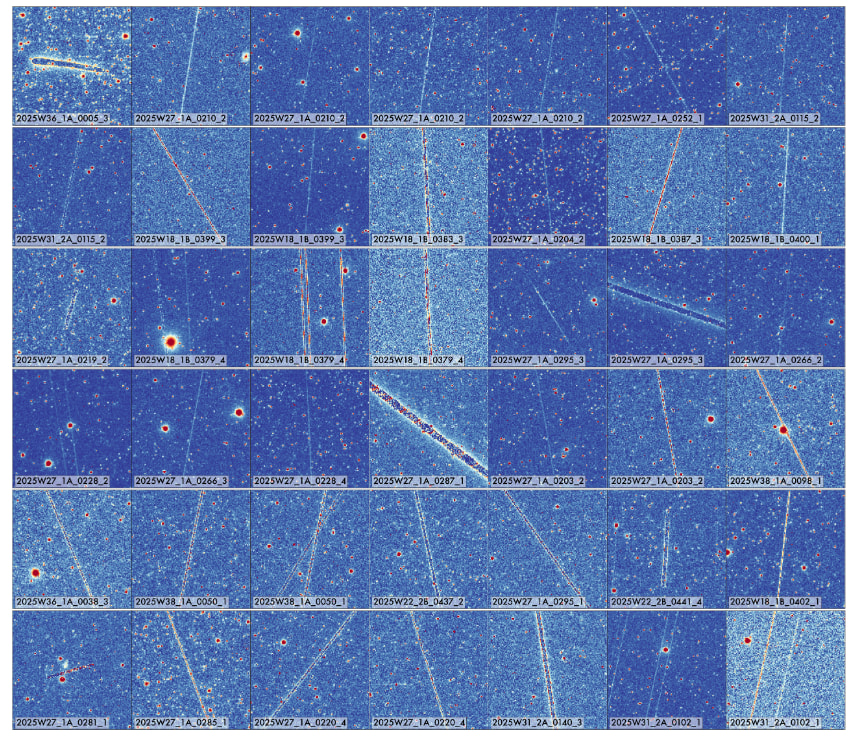

 Da Sky & Telescope: