ESA ha impiegato una AI per ri-analizzare l’archivio di immagini prodotte da Hubble. Sono stati scoperti 1400 “oggetti anomali”, 800 dei quali mai documentati.
 Il comunicato sul sito di ESA:
The team developed what’s called a neural network, an AI tool that uses computers to process data and search for patterns in a way that is inspired by the human brain. Their neural network, which they named AnomalyMatch, is trained to search for and recognise rare objects like jellyfish galaxies and gravitational arcs.
The team used AnomalyMatch to search through nearly 100 million image cutouts from the Hubble Legacy Archive, marking the first time the archive has been systematically searched for astrophysical anomalies. In just two and a half days, AnomalyMatch completed its search of the archive and returned a list of likely anomalies.
As the process of tracking down rare objects still requires an expert eye, David and Pablo personally inspected the sources rated by their algorithm as most likely to be anomalous. Of these, more than 1300 were true anomalies, more than 800 of which had never been documented in the scientific literature.
 Alcune immagini:
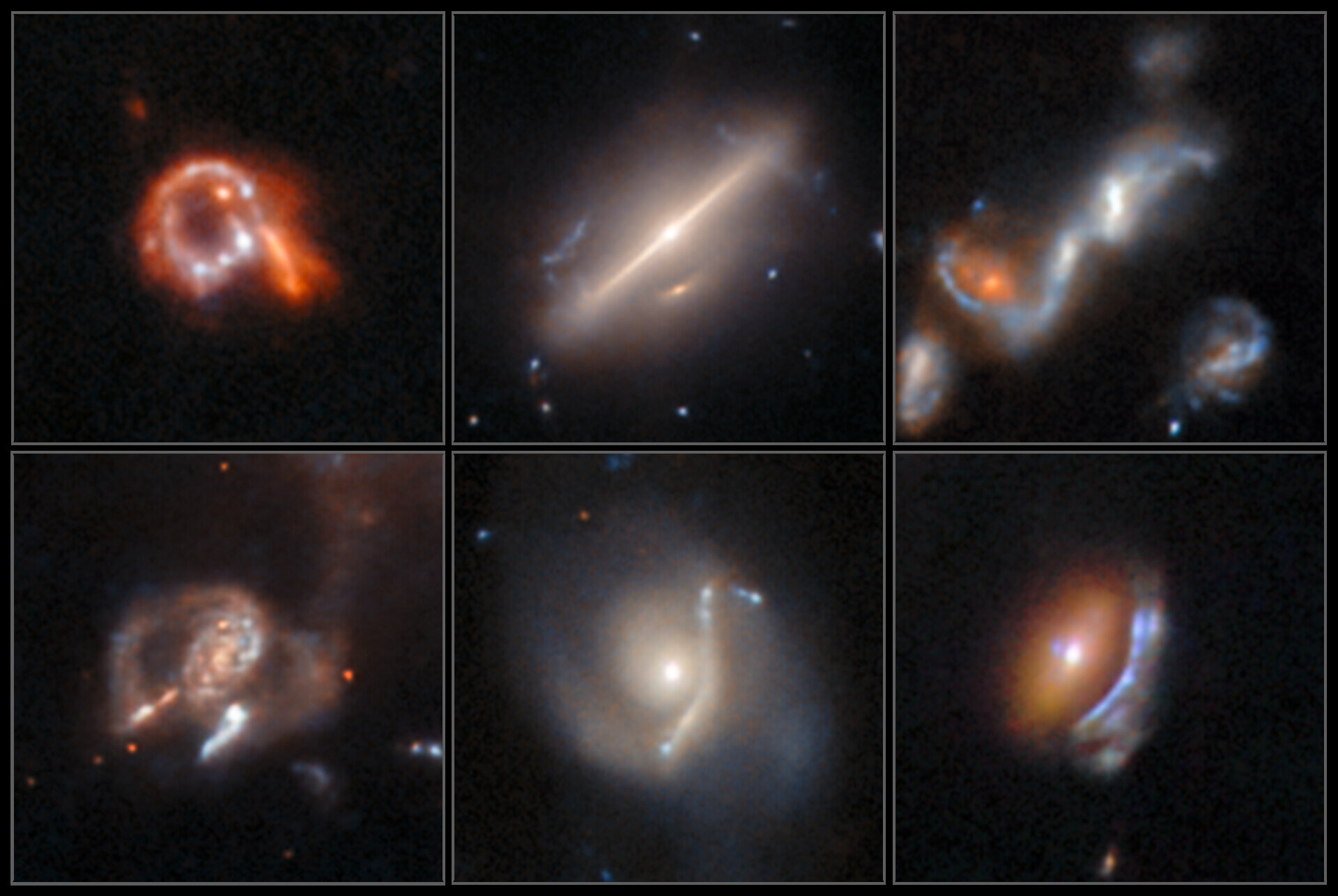
A collage of six images, showing different kinds of “anomalous” astrophysical objects. These are galaxies with unusual shapes, among them a ring-shaped galaxy, a bipolar galaxy, a group of merging galaxies, and three galaxies with warped arcs created by gravitational lensing.
 Il paper:
We have systematically searched approximately 100 million image cutouts from the entire Hubble Legacy Archive using the recently developed AnomalyMatch method, which combines semi-supervised and active learning techniques for the efficient detection of astrophysical anomalies. This comprehensive search rapidly uncovered a multitude of astrophysical anomalies presented here that significantly expand the inventory of known rare objects.
Among our discoveries are 86 new candidate gravitational lenses, 18 jellyfish galaxies, and 417 mergers or interacting galaxies. The efficiency and accuracy of our iterative detection strategy allows us to trawl the complete archive within just 2–3 days, highlighting its potential for large-scale astronomical surveys.
 Ping:
Ping: