Segnalo due paper.
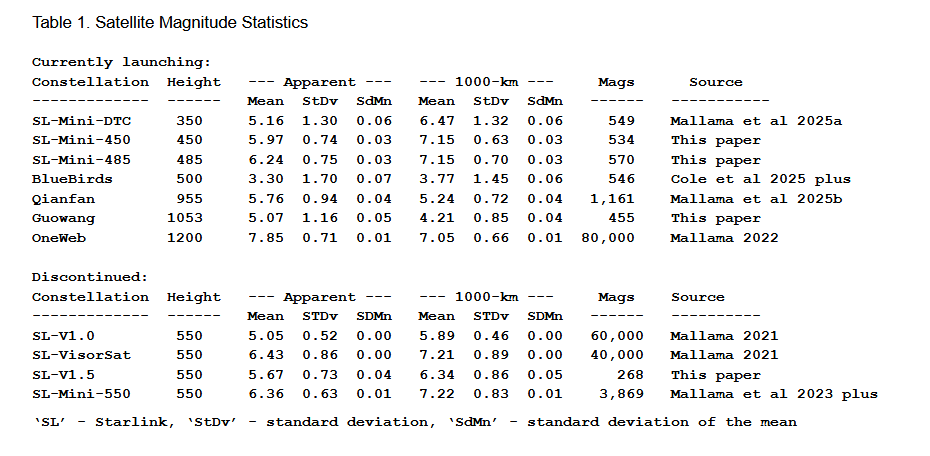
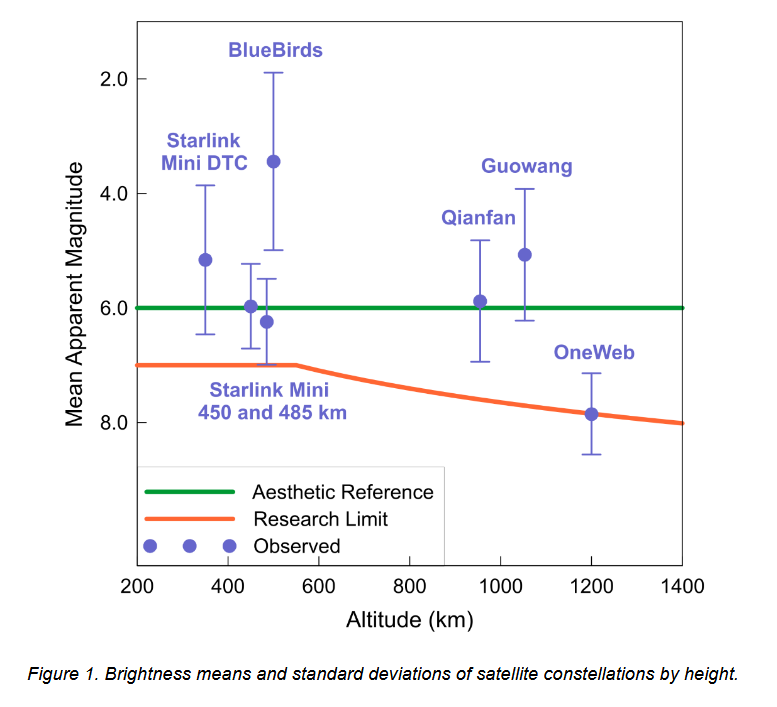
Uno con i dati relativi alle varie costellazioni di satelliti.
 Satellite Constellations Exceed the Limits of Acceptable Brightness Established by the IAU
Brightness statistics for satellites of the Starlink, BlueBird, Qianfan, Guowang and OneWeb constellations are reported. The means and standard deviations are compared to acceptable limits set by the International Astronomical Union’s Centre for the Protection of the Dark and Quiet Sky From Satellite Constellations Interference. Nearly all these spacecraft exceed the magnitude 7+ brightness limit pertaining to interference with professional research. Most also exceed the magnitude 6 reference where they distract from aesthetic appreciation of the night sky.
Il secondo si concentra su BlueBird, di cui si era scritto sopra nel thread:
Initial Observations of the First BlueBird Spacecraft and a Model of Their Brightness
The large satellites launched by AST SpaceMobile (AST) are a special concern because
they can be very bright. The luminosity of their BlueWalker 3 prototype satellite was characterized by Mallama et al. (2023 and 2024). Now, AST has launched the initial five spacecraft of their follow-on BlueBird constellation. This paper reports on their magnitudes.
Based on a large set of visual observations, the mean apparent magnitude of BlueBird satellites is 3.44, while the mean of magnitudes adjusted to a uniform distance of 1000 km is 3.84. Near zenith the spacecraft can be as bright as magnitude 0.5. While these spacecraft are bright enough to impact astronomical observations, they can for periods be fainter than the BlueWalker 3 prototype satellite. A model for their brightness shows that design changes since the BlueWalker 3 mission can explain the behavior of BlueBird.