Forse dopo il contatto al suolo, il lander è rotolato
1 Mi Piace
Sto preparando un transcript delle cose piu’ salienti della conferenza stampa, per poter discutere sulla base delle dichiarazioni dei partecipanti.
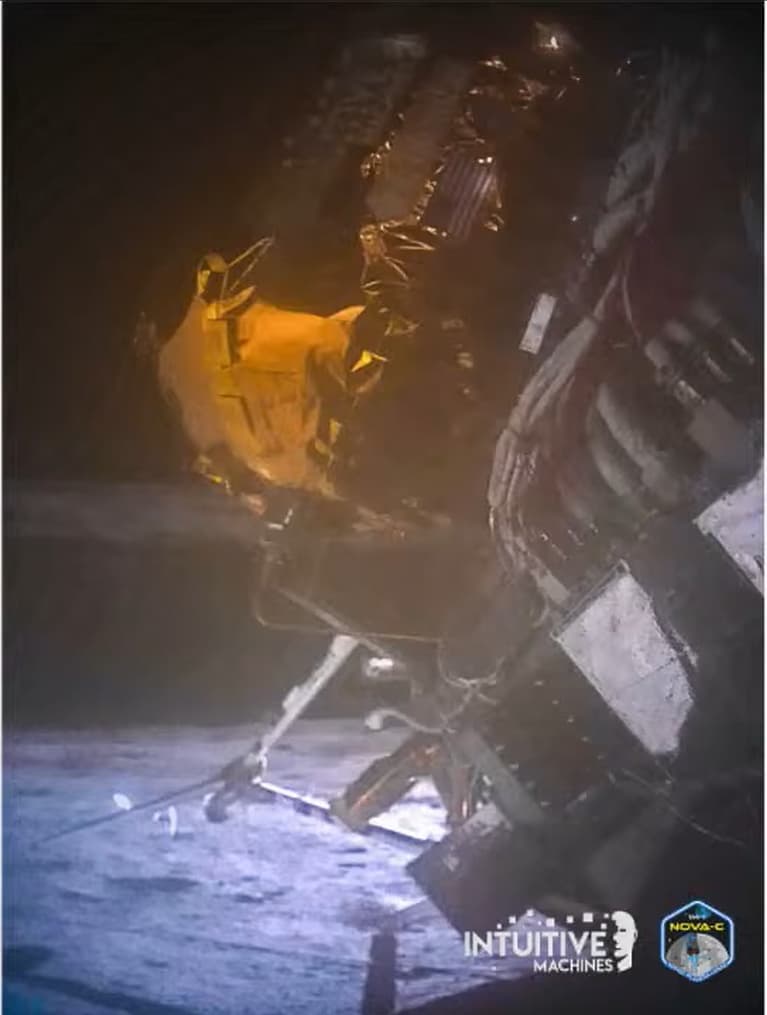
Comunque credo @Aran_Benjo abbia ragione. Dopo il primo contatto con la superficie, con rottura di almeno una delle zampe, Odysseus deve aver ruotato prima di accasciarsi a 30 gradi perche’ in questa immagine mostrata in conferenza stampa mostra chiaramente che una delle zampe spezzate e rivolta verso l’alto.
 Intuitive Machines
Il commento a questa immagine
And here we are. Our Ody conducted a brilliant six-day mission on the surface. You see, the gold foil blanket is the helium tank. You see we’ve tilted over slightly, still more upright than we initially thought.
We did land upright, we captured data, and then we tilted over slowly in two seconds, then came to rest on the opposite helium tank or on the computer shelf, and we were able to communicate all six payload data back and all
the commercial payloads then continue to transmit as we go forward.
tradotto (enfasi mie)
Ed eccoci qui. Il nostro Ody ha condotto una brillante missione di sei giorni sulla superficie. La copertura dorata che vedete è il serbatoio dell’elio. Come vedete siamo leggermente inclinati, ma comunque più verticali di quanto pensassimo inizialmente.
Siamo atterrati in posizione verticale, abbiamo acquisito i dati e poi ci siamo inclinati lentamente in due secondi, quindi ci siamo fermati poggiandoci sull’altro serbatoio di elio o sul supporto del computer, e siamo stati in grado di inviare i dati di tutti e sei i carichi utili e dei payload commerciali, e continuiamo a trasmettere mentre proseguiamo.
7 Mi Piace
Un altro pezzo di transcript. Tim Crain CTO e cofounder di IM, rispode a una domanda con l’elenco dei problemi piu’ grandi incontrati in questa missione.
There were a number of things we had to overcome. Some of them actually began before flight.
We had warm methane on our first day of flight, and we had to work with spacex to adjust that to get ready to go for the second day, and so we overcame that.
I think we published the star tracker issue, which was, we had too tight of a tolerance check on a numerical condition for the measurements coming out of the star tracker. That prevented our vehicle from staging all the way to a sun-pointing power positive, so we had to patch the interface with the star tracker to fix that. If don’t fix that, the mission ends quickly. But the team was wery effective on that.
Another one that probably kicks off a few of those, we discovered in our commissioning maneuver that we had a drift in the yaw channel of the main engine control. During the main engine burn the way we steer the vehicle is actually gimbal the motor, so you turn it one way, it helps provide control on these two axes. We were drifting to one side during the commissioning maneuver, and then we saw it again in TCM1. So what we had to do to troubleshoot that was to come up with scenarios where engine geometry understanding and control would lead us into that drift. We knew we could do the small burns but not going to be sufficient for the longer burns of LOI and power descent. So we did a couple of troubleshooting steps there. One was, we moved the CG estimate on the vehicle around, which we suspecteds was not really the case, but mimicked the signature we were seeing. And then we did a patch on our engine geometry, which it was what we call an I-load set, or parameters that the software reads kinda from a flat file. We updated our I-loads to redefine the engine geometry because we began to understand tha under full thrust load, the geomety of our actuators were slightly different. And so we were able to patch these and that and led us to a successful LOI and a successful power descent. I will tell that on the day of landing, when we watched the pointing control come across the consoles, it really looke like a video game. It was so good. I had never, in any of our simulations, seen the engine perform as well as it was after we tuned it up through those burns. But if we had not done that, then we would not have been able to land on the moon. So those are big steps for us.
We pubshed a few things about learning how to chill our engine. We do have a cryogenic engine and have to chill the metal of the engine itself before we can fire the engine. Our first commissioning maneouvre we didn’t get it right on the methane side, and we had to try again, and fired successfully but not on time for the commissioning maneuver. We came back and reloaded for our first correction maneouvre, TCM1, and we missed the other side, the oxygen side. I may have them backwards… We missed the oxygen on the first one and we missed methane on the second one. And we had to reload, and a couple hours later we came back and dialed that in. From that burn on though, we had it perfected, and the next five burns, the process that we tuned once we were in orbit, we hit all five burns exactly on time with ignition. If i get to the Moon and i miss LOI by even a minute, we don’t land on the Moon. It’s very precise. So that was another one we overcame.
We did end up in a lower orbit after LOI than we anticipated the. walow. Fortunately our Flight Dynamics engineers preloaded the ability to do a lunar correction maneuver and we were able to push that up and move the orbit from the planned lunar orbit, which would be 100 km circular, basically into something close to the desccent orbit. So, effectively, we had the agility in our con control room to move the orbit insertion from orbit 12 to orbit 3, or something like that.
We discovered the laser range finders were not working. Again, it was an interface issue. We talked a litt bit about that. There is a pin in the cable that is a safety feature, that once you put that in, you cannot see if the pin is in place or not. It’s a type 4 laser so we didn’t test it once we got tot the cape. Clearly somethi we can fix and rectify in testing on the next time through. Nonetheless, the vehicle performed just with our optical navigation system aboveexpectations, and it allowed us to land safely.
And then there were a number of other things that don’t rise to the same level. A lot of the things were crisis anticipated, identified, and resolved before they impacted he mission. And so the team was excellent in saying, OK, if this is the challenge we are faced with, this is the resolution, and how do we marshal the resources in that control room and with our backup team, to make sure they did not impact our ability to land safely.
traduzione (enfasi mie)
C’è stata serie di difficoltà che abbiamo dovuto superare. Alcuni di esse in realtà sono iniziate ancora prima di volare.
Avevamo metano a temperatura troppo alta durante il primo giorno previsto per il decollo, e abbiamo dovuto lavorare con SpaceX per adattarlo e prepararci a partire per il secondo giorno, e così abbiamo superato il problema.
Penso che abbiamo pubblicato qualcosa sui problemi con lo star tracker, ovvero che avevamo una tolleranza troppo rigida su una calibrazione numerica per la telemetria proveniente dallo star tracker. Ciò ha impedito al nostro veicolo di configurarsi in modo corretto nella modalità “sun pointing”, quindi abbiamo dovuto patchare l’interfaccia dello star tracker per risolvere il problema. Se non avessimo risolto questo problema, la missione sarebbe finita rapidamente. Ma il team è stato molto efficace in questo senso.
Un altro punto che probabilmente risponde ad alcune delle domande, è abbiamo scoperto durante la nostra di commissioning che avevamo una deriva nel canale di imbardata del controllo del motore principale. Durante l’accensione del motore principale, il modo in cui sterziamo il veicolo è di muovere il motore sul giunto cardanico, e quindi girandolo in varie direzioni, aiuta a fornire il controllo su questi due assi (mostra il movimento con un modellino, ndt). Stavamo derivando verso una certa direzione, durante la manovra di commissioning, cosa che poi abbiamo rivisto di nuovo in TCM1 (una manovra correttiva successiva, ndt). Quindi quello che dovevamo fare per risolvere il problema era creare scenari in cui la comprensione e il controllo della geometria del motore ci avrebbero portato a quella deriva. Sapevamo che avremmo potuto eseguire senza problemi piccole accensioni, ma non andavano bene accensioni più lunghe, come la LOI o la manovra di discesa. Quindi abbiamo sistemato un paio di cose in tal senso. Una, abbiamo spostato la stima del centro di gravità sul veicolo, cosa che sospettavamo non fosse proprio il problema, ma abbiamo imitato la “firma” che avevamo osservato. Poi abbiamo apportato una patch alla geometria del nostro motore, che è quello che chiamiamo set I-load, cioè a parametri che il software legge da un file. Abbiamo aggiornato i nostri I-load per ridefinire la geometria del motore perché abbiamo iniziato a capire che, a pieno carico di spinta, la geometria dei nostri attuatori era leggermente diversa. E così siamo stati in grado di correggerli, e quei valori ci hanno portato a una LOI di successo e ad una manovra di discesa di successo. Vi dirò che il giorno dell’atterraggio, quando abbiamo visto il controllo del puntamento arrivare sulle console, sembrava davvero un videogioco. Era davvero eccellente. Non avevo mai visto, in nessuna delle nostre simulazioni, il motore funzionare così bene come dopo averlo messo a punto durante quelle accensioni. Ma se non lo avessimo fatto non saremmo riusciti a sbarcare sulla Luna. Quindi questi sono stati passi molto importanti per noi.
Abbiamo pubblicato alcune cose su come abbiamo imparato a raffreddare il nostro motore. Abbiamo un motore criogenico e dobbiamo raffreddare il metallo del motore stesso prima di poterlo accendere. La nostra prima manovra di commissioning non è stata corretta per quanto riguarda il metano, quindi abbiamo dovuto riprovare e abbiamo acceso con successo, ma non al momento che avevamo previsto per la manovra di commissioning. Abbiamo rivisto il tutto e ci siamo preparati per per la nostra prima manovra di correzione, TCM1. Ma qui abbiamo sbagliato dall’altro lato, il lato dell’ossigeno. Potrei averli detti al contrario… Nel primo caso abbiamo sbagliato con l’ossigeno e nel secondo con il metano. E abbiamo dovuto ripartire da capo, e un paio d’ore dopo siamo tornati e abbiamo messo a punto il tutto. Da quell’accensione in poi, però, abbiamo perfezionato il metodo, e nelle cinque accensioni successive, con il processo che abbiamo messo a punto una volta che eravamo in orbita abbiamo eseguito tutte e cinque le successive accensioni esattamente al momento previsto. Se avvicinandosi alla sulla Luna si manca il momento esatto per la LOI anche solo di un minuto, non si atterra sulla Luna. E’ una manovra molto precisa. Quindi quello è stato un altro ostacolo che abbiamo superato.
Dopo la manovra LOI siamo finiti in un’orbita più bassa di quanto ci aspettassimo. Fortunatamente i nostri ingegneri di Flight Dynamics avevano pre-caricato la capacità di eseguire una manovra di correzione lunare e siamo stati in grado di alzarci e spostarci l’orbita dall’orbita lunare pianificata, che sarebbe stata circolare a 100 km di quota, a praticamente qualcosa di vicino all’orbita di discesa. Quindi, in effetti, abbiamo avuto l’agilità nella nostra sala di controllo di saper spostare l’inserimento dell’orbita dall’orbita 12 all’orbita 3, o qualcosa del genere.
Abbiamo scoperto che i telemetri laser non funzionavano. Ancora una volta, si è trattato di un problema di interfaccia. Ne abbiamo già parlato in precedenza. Nel cavo è presente un perno che fa da sicurezza e, una volta inserito, non è possibile vedere se tale perno è in posizione o meno. Si tratta di un laser di tipo 4, quindi non l’abbiamo testato una volta arrivati a Cape (Canaveral). Chiaramente è qualcosa che possiamo sistemare e correggere nei test la prossima volta. Tuttavia, il veicolo ha funzionato bene anche solo con il nostro sistema di navigazione ottica, al di sopra delle aspettative, e ci ha permesso di atterrare in sicurezza.
E poi ci sono state una serie di altre cose che non avevano lo stesso livello di gravità. Molte delle crisi sono state anticipate, identificate e risolte prima che incidessero sulla missione. E quindi il team è stato eccellente nel dire: OK, se questa è la sfida che dobbiamo affrontare, questa è la soluzione, e così è come possiamo organizzare le risorse in quella sala di controllo e il nostro team di backup, per assicurarci che non abbiano alcun impatto sulla la nostra capacità di atterrare in sicurezza.
8 Mi Piace
Odysseus funziona ancora, inoltre sperano che si possa risvegliare dopo la notte lunare.
https://twitter.com/Int_Machines/status/1763223378293395535?t=NMLRTuG0PMg7XZaLujWOvw&s=19
Ok che ce l’ha fatta SLIM, ma è l’unica della storia lunare a non avere plutonio e riprendere le comunicazioni.
4 Mi Piace
Tutto questo a dimostrazione del fatto che andare sulla Luna (che sembra dietro l’angolo) certo si riesce, si va e ci ritorneremo… ma NON é semplice.
Pertanto tanto di cappello a IM, a maggior ragione a tutti coloro tra ingegneri e specialisti che negli anni 60’ con i mezzi dell’epoca sono riusciti a portare l’umanità sulla Luna.
6 Mi Piace
Nuovo articolo di Simone Montrasio pubblicato su AstronautiNEWS.it.
5 Mi Piace
Versione accelerata dell’atterraggio:
https://twitter.com/SegerYu/status/1765222907620499581
3 Mi Piace

2 Mi Piace
Intuitive Machine comunica la fine della missione
IM-1 Lunar Night Update: Farewell Odysseus
As previously announced on February 29th, our IM-1 mission ended seven days after landing, as Odysseus’ mission was not intended to survive the harsh temperatures of the lunar night. Before its batteries were depleted, flight controllers tucked Odie into a configuration that could call home if various systems outperformed manufacturer expectations.
Intuitive Machines started listening for Odie’s wake-up signal on March 20, when we projected enough sunlight would potentially charge the lander’s power system and turn on its radio.
As of March 23rd at 1030 A.M. Central Standard Time, flight controllers decided their projections were correct, and Odie’s power system would not complete another call home. This confirms that Odie has permanently faded after cementing its legacy into history as the first commercial lunar lander to land on the Moon.
3 Mi Piace
Qualche risultato scientifico lo ha comunque ottenuto. ROLSES, un radiotelescopio a bordo del lander, ha registrato i segnali radio terrestri durante il transito verso la luna e, per una ventina di minuti, dalla superficie lunare.
Along the way to the Moon, ROLSES repeated a famous Carl Sagan experiment from 1993: It captured the spectrum of radio waves pouring from our planet out into space. What they measured was an electronic fingerprint of all the wavelengths of radio broadcasts that passing aliens could see if they, too, pointed a radio spectrometer at Earth. They hope the data will give them a more detailed idea of what to look for in radio data from planets around nearby stars.
“We were supposed to have 8 days worth of data. We ended up with an hour and a half to 2 hours worth of data,” says Burns. ROLSES spent only about 20 minutes doing radio astronomy from the surface of the Moon.[…]
Because the observation time was so short, the data is more noise than signal. The rest, about an hour and a half of much clearer data, was collected on the way to the Moon, when ROLSES wasn’t supposed to have been up and running at all, which underscores how much of spaceflight still relies on being able to improvise quickly.

One of the antennas on the ROLSES instrument deployed partway to the Moon, so Burns and his colleagues decided they might as well take some measurements of Earth — and it’s a good thing they did, because they only got about 20 minutes’ worth of data once ROLSES landed on the Moon. Credit Intuitive Machines and Jack Burns
Il paper della ricerca è uscito ieri:

Radiowave Observations on the Lunar Surface of the photo-Electron Sheath instrument (ROLSES- 1) onboard the Intuitive Machines’ Odysseus lunar lander represents NASA’s first radio telescope on the Moon. […] All antennas recorded shortwave radio transmissions breaking through the Earth’s ionosphere – or terrestrial technosignatures – from spectral and raw waveform data. These technosignatures appear to be modulated by density fluctuations in the Earth’s ionosphere and could be used as markers when searching for extraterrestrial intelligence from habitable exoplanets. […] ROLSES-1 represents a trailblazer for lunar radio telescopes, and many of the statistical tools and data reduction techniques presented in this work will be invaluable for upcoming lunar radio telescope missions.
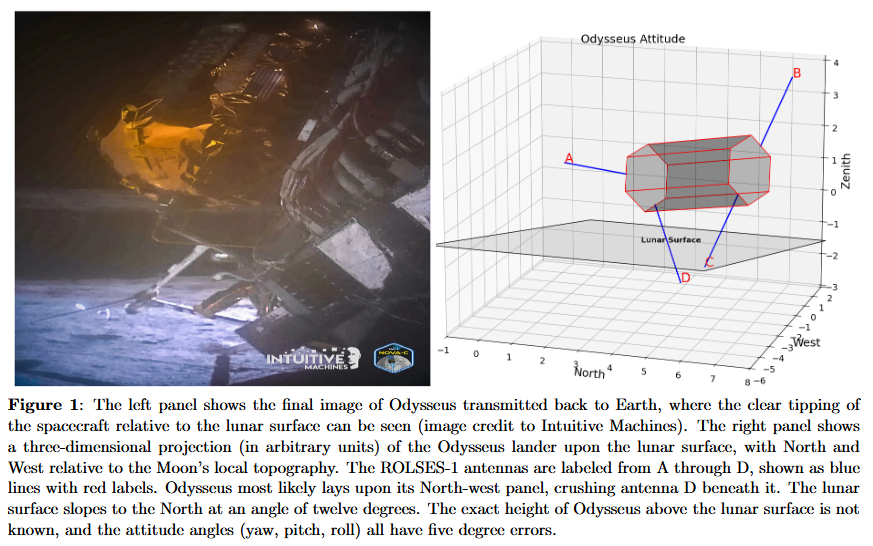
Due articoli su ROLSES.
4 Mi Piace