(Traduzione automatica) La missione Active Debris Removal di Astroscale-Japan (ADRAS-J) consiste in un veicolo spaziale sviluppato e gestito da Astroscale con l’obiettivo di incontrarsi e caratterizzare un grande pezzo di detriti. Il suo obiettivo è lo stadio superiore H-2A rimasto nell’orbita terrestre bassa dopo il lancio del satellite di osservazione della Terra GOSAT nel 2009.
Segnalo questo interessante dimostratore tecnologico giapponese ADRAS-J lanciato il 18/02 da Rocket Lab, per la rimozione di grossi detriti spaziali.
Si avvicinerà ad un vecchio stadio H2-A in orbita LEO ca.600 km dal 2009 per testare le capacità di un rendez-vous (docking e rientro controllato non previsto in questa prima missione)
“We are targeting to go closer, maybe 1 to 2 meters away from the object. Why? Because the next mission will be to really capture the H-IIA launch vehicle,” Kato told Ars last week. "In order to safely approach to a range where a robotic arm is able to be extended, it’s probably like 1.5 to 2 meters away from the object. We want to demonstrate up to that point through this ADRAS-J mission. Then on the next mission, called ADRAS-J2, we are actually equipping the robotic arm and capturing the H-IIA launch vehicle.”
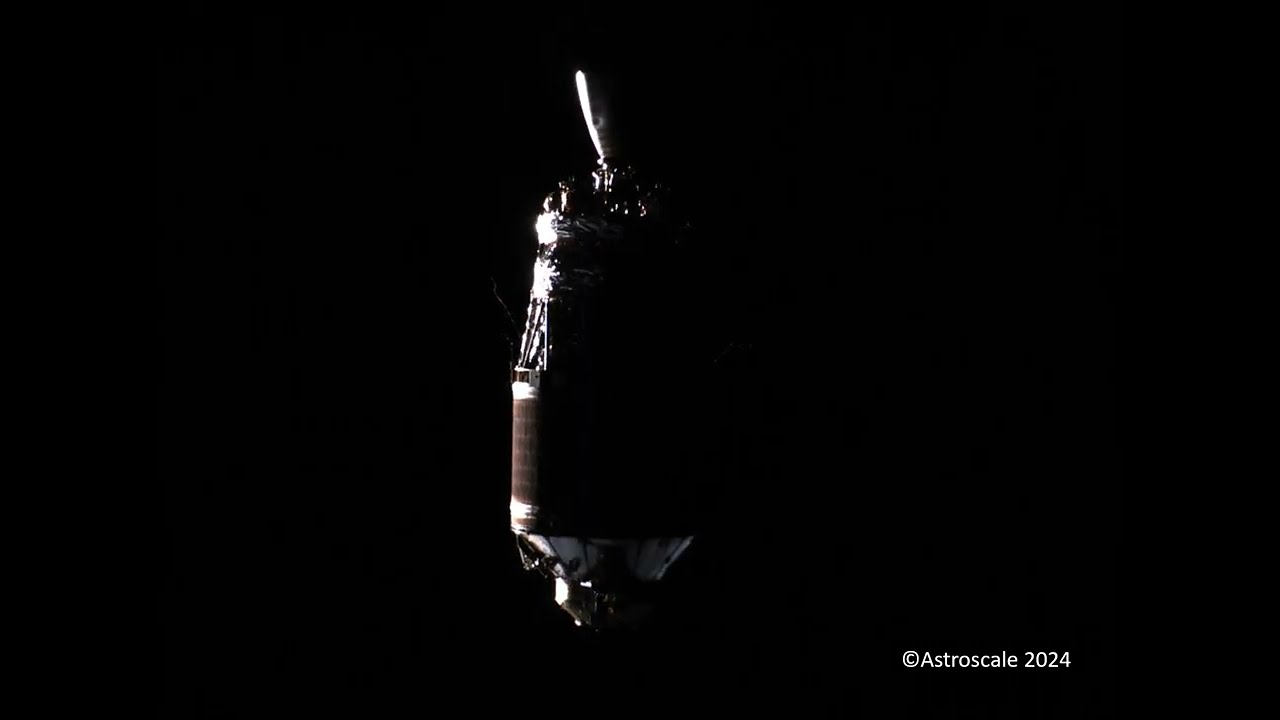
ADRAS-J (Active Debris Removal), un satellite di Astroscale, ha raggiunto e fotografato un detrito in orbita.
The image was taken by its commercial debris inspection demonstration satellite, Active Debris Removal by Astroscale-Japan (ADRAS-J), from several hundred meters behind the space debris, a rocket upper stage. The unprecedented image marks a crucial step towards understanding and addressing the challenges posed by space debris, driving progress toward a safer and more sustainable space environment.
Un articolo della BBC dà qualche informazione in più sul detrito.
The object is a discarded rocket segment that’s about 11m by 4m (36ft by 15ft), with a mass of three tonnes. […] The one in the new image came from Japan’s H-IIA launch vehicle, which lofted a CO2-measuring spacecraft called Gosat, in 2009. The upper-section of the rocket ejected Gosat at an altitude of roughly 600km.
On May 23, Astroscale Japan Inc. successfully carried out the “fixed-point observation service” with ADRAS-J, maintaining a distance of approximately 50 meters from the target while adhering to JAXA’s safety requirements.
The images obtained confirm that the movement of the target space debris is in a vertical attitude along the nadir direction, with hardly any rotation around its long axis. It was also confirmed that the debris shows no significant damage. The string-like objects observed on either side of the body are presumed to be surface protection tapes which are also seen in the launch operation images.
Anomalia per ADRAS-J mentre manovrava intorno all’upper stage di un H-2A che ha raggiunto mesi fa. Manovra abortita e per fortuna nessuna collisione.
The fly-around observation involved a complex, autonomous operation to maneuver ADRAS-J around the upper stage client for continuous image-taking, providing more insights into its characteristics and movement. These operations utilized relative navigation data from the Light Detection and Ranging (LiDAR) sensor, along with custom-developed software algorithms for alignment and control. ADRAS-J maintained a fixed distance of approximately 50 meters during the fly-around operations to capture images of the client, facilitating assessment for potential future removal. When ADRAS-J was approximately one-third through the fly-around observation (~120 degrees), an autonomous abort was triggered by the onboard collision avoidance system due to an unexpected attitude anomaly, and ADRAS-J safely maneuvered away from the client as designed.