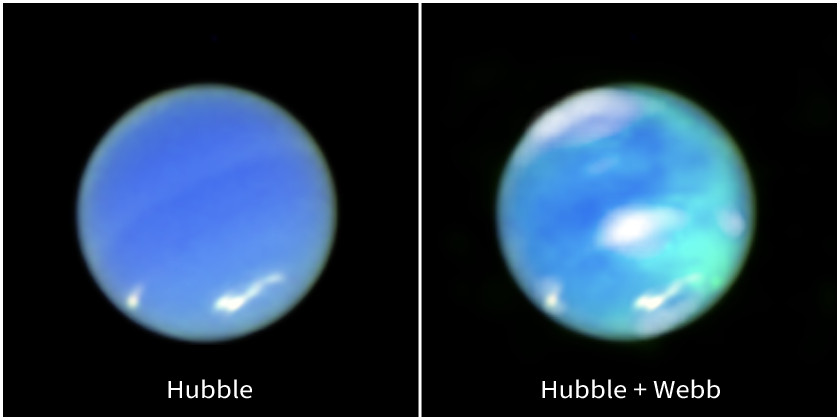
The Near-Infrared Spectrograph on the James Webb Space Telescope picked up cyan splotches of auroral activity, right, that could not be picked up by the Hubble, left, and other telescopes in the past. Credit: NASA/ESA/CSA James Webb Space Telescope
The new Webb observations also reveal why Neptune’s auroras have been invisible until now. Nearly 40 years ago, Voyager 2 recorded a temperature of around 900 degrees Fahrenheit for Neptune’s upper atmosphere. But the Webb telescope shows that the temperature has dropped, to close to 200 degrees. That lower temperature means the auroras are dimmer.
In fact, Neptune’s aurora is glowing “with less than 1 percent of the brightness we expected, explaining why we haven’t seen it,” said James O’Donoghue, a planetary astronomer at the University of Reading in England and one of the study’s authors. “However, that means we now have a new mystery on our hands: How has Neptune cooled down so much?”
Here, using observations from the James Webb Space Telescope, we detect H₃⁺ at Neptune, as well as distinct infrared southern auroral emissions. The average upper-atmosphere temperature is a factor of two cooler than those derived 34 years ago by Voyager 2, showing that the energy balance of this region is regulated by physical processes acting on a timescale shorter than both Neptunian seasons (40 yr) and the solar cycle.
The lensing galaxy at the center of this Einstein ring is an elliptical galaxy, as can be seen from the galaxy’s bright core and smooth, featureless body. This galaxy belongs to a galaxy cluster named SMACSJ0028.2-7537. The lensed galaxy wrapped around the elliptical galaxy is a spiral galaxy. Even though its image has been warped as its light travelled around the galaxy in its path, individual star clusters and gas structures are clearly visible.
800.000 galassie in 37 immagini vuol dire 20.000 galassie per immagine. E solo su una piccolissima area di cielo, che è logico perché WSJT non è un telescopio per survey.
Non so che ricerche si possano fare su quel catalogo, ma chi lavora sull’evoluzione galattica si tufferà a pesce Paperon de’ Paperoni style
A proposito di info che si possono trarre da dati gia’ disponibili, mi ha particolarmente colpito la seguente notizia. Premetto che non so se sono dati provieniente anche dal Webb, quindi e’ ai limiti dell’OT ma serve per seguire il filo logico.
In partica, se ho capito bene, organizzando uno show basato su dati astronomici si sono evidenziate delle strutture a spirale nella nube di Oort che prima non erano state notate.
Sembra che gli oggetti si dispongano in bracci a spirale. Proprio come per le galassie, ma in scala piu’ ridotta. Poi la mia domanda da ignorante sarebbe capire se la meccanica e gli effetti fisici alla base di queste strutture se confermate siano le stesse sia per le galassie che per la nube di Oort ma immagino di non essere l’unico a farsi questa domanda.
E’ solo un esempio per dire che dati ben conosciuti e disponibili se presentati graficamente in altro modo possono fornire piu’ informazioni. Non parlo di scandagliarli con l’AI, parlo di disegnarli in modo diverso per intelligenze naturali osservatrici. In questo terabyte e mezzo c’e’ tanta roba e mi aspetto che l’astronomia sara’ sempre piu’ interpretare i dati disponibili.
Di seguito le notizie, se ben noto o non fondato chiedo scusa:
Prima immagine diretta di un esopianeta per il JWST. (forse)
Il telescopio spaziale James Webb ha rilevato una debole sorgente infrarossa nel disco di detriti attorno alla stella Twa 7, compatibile con la presenza di un pianeta giovane, freddo e con una massa simile a quella di Saturno. Se confermata, questa osservazione sarebbe la prima immagine diretta di un esopianeta del Jwst.
I comunicati di ESA e del CNRS, l’ente che ha guidato la ricerca:
Here we have used the unprecedented sensitivity of the James Webb Space Telescope’s Mid-Infrared Instrument in the thermal infrared to search for such planets in the disk of the approximately 6.4-Myr-old star TWA7. With its pole-on orientation, this three-ring debris disk is indeed ideally suited for such a detection. We unambiguously detected a source 1.5arcsec from the star, which is best interpreted as a cold, sub-Jupiter-mass planet. Its estimated mass (about 0.3MJ) and position (about 52au, de-projected) can thoroughly account for the main disk structures.
Ricordiamo che Alfa Centauri è composto da 3 stelle: A, B e C. Questo esopianeta orbiterebbe intorno ad Alfa Centauri A. Gli unici esopianeti confermati sono intorno ad Alfa Centauri C.
Una sorta di “riassunto” di quello che è stato scoperto dal JWST nel primo anno e mezzo di attività è stato raccolto dall’ISSI durante il 2024 ISSI Breakthrough Workshop e pubblicato su Nature Astronomy.
A new Perspective published in Nature Astronomy provides the most comprehensive snapshot yet of the Universe’s first Billion years, as revealed by the James Webb Space Telescope (JWST). Drawn from the collective insights of an international assemblage of leading astronomers, the work charts a transformative moment in cosmic research—an era where science textbooks are being rewritten in real time. […]
This perspective spans several key areas of discovery:
A current census of early galaxies: their luminosities, structures, masses, and formation histories.
The detection of chemical signatures in the earliest stars and galaxies, offering clues to their life cycles and enrichment processes.
The discovery of massive black holes at unexpectedly early times, and what they reveal about black hole formation and growth.
An in-depth look at the sources of cosmic reionization, and the emerging understanding of how the Universe became transparent to light.
[…] as a result of the 2024 ISSI Breakthrough Workshop, we provide a snapshot of the great progress made towards understanding the initial chapters of our cosmic history 1.5 years into the JWST science mission. We present the current census of early galaxies, their luminosities, appearance, chemical composition, masses and formation histories as revealed by JWST. We relate the discovery of massive black holes in early galaxies and discuss their demographics and implications for their formations and growth. We conclude by describing the potential sources of reionization and our current understanding of how the Universe became fully ionized. Throughout the Perspective, we highlight discoveries and breakthroughs, topics and issues that are not yet understood, and questions that will be addressed in the coming years, as JWST continues its revolutionary observations of the early Universe.
JWST ha trovato quello che potrebbe essere il cantiere di una eso-luna: un disco circumplanetario intorno a un eso-pianeta.
Il comunicato stampa della NASA:
NASA’s James Webb Space Telescope has provided the first direct measurements of the chemical and physical properties of a potential moon-forming disk encircling a large exoplanet. The carbon-rich disk surrounding the world called CT Cha b, which is located 625 light-years away from Earth, is a possible construction yard for moons, although no moons are detected in the Webb data.
An artistic rendering of a dust and gas disk encircling the young exoplanet, CT Cha b, 625 light-years from Earth. Spectroscopic data from NASA’s James Webb Space Telescope suggests the disk contains the raw materials for moon formation: diacetylene, hydrogen cyanide, propyne, acetylene, ethane, carbon dioxide, and benzene. The planet appears at lower right, while its host star and surrounding circumstellar disk are visible in the background. Illustration: NASA, ESA, CSA, STScI, Gabriele Cugno (University of Zürich, NCCR PlanetS), Sierra Grant (Carnegie Institution for Science), Joseph Olmsted (STScI), Leah Hustak (STScI)
[…] We present the mid-infrared spectrum from the CPD surrounding the young companion CT Cha b. The data show a carbon-rich chemistry with seven carbon-bearing molecules (up to C6H6) and one isotopolog detected and indicate a high gaseous C/O > 1 that is in contrast with the elemental abundance ratios typically measured in directly imaged gas giant atmospheres. This carbon-rich chemistry is also in stark contrast to the spectrum of the disk surrounding the host star, CT Cha A, which shows no carbon-bearing molecules. This difference in disk chemistry between the host disk and its companion indicates rapid, divergent chemical evolution on ∼million-year timescales. Nonetheless, the chemical properties of the CPD follow trends observed in isolated objects, where disks transition from an oxygen-rich to carbon-rich composition with decreasing host mass. Our results provide the first direct insight into the chemical and physical properties of material being accreted onto a gas giant analog and into its potential moon system.
If Artemis II launches in February, the impact on JWST DSN usage will be negligible. A March launch will result in modest but manageable impacts. If the launch slips to April, JWST may execute significantly fewer science observations for approximately one week, depending on the exact launch date.
 Auroras Are Spotted on Neptune for the First Time, and Lead to a New Mystery
 Discovery of H₃⁺ and infrared aurorae at Neptune with JWST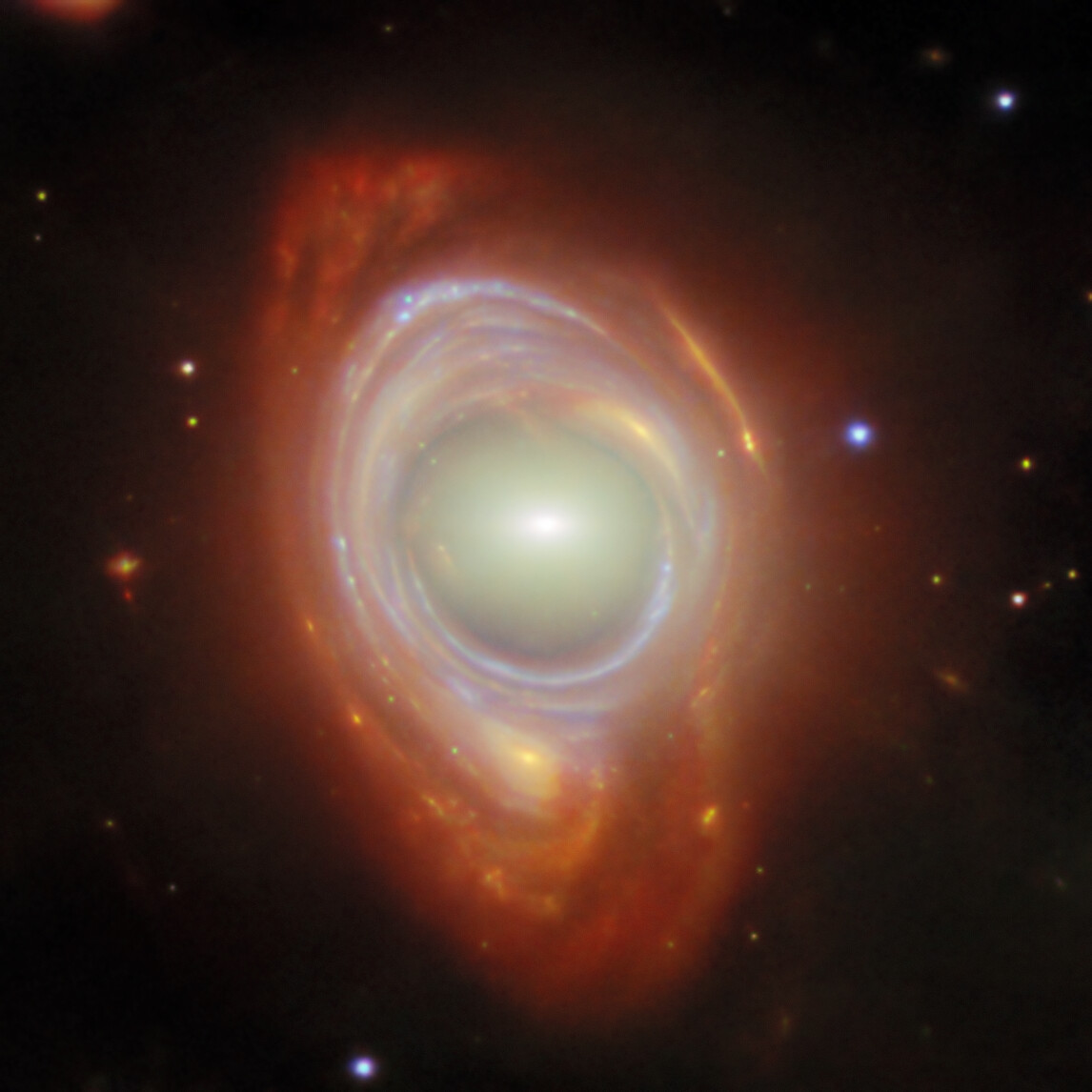


 I comunicati di ESA e del CNRS, l’ente che ha guidato la ricerca:

 Thread di presentazione: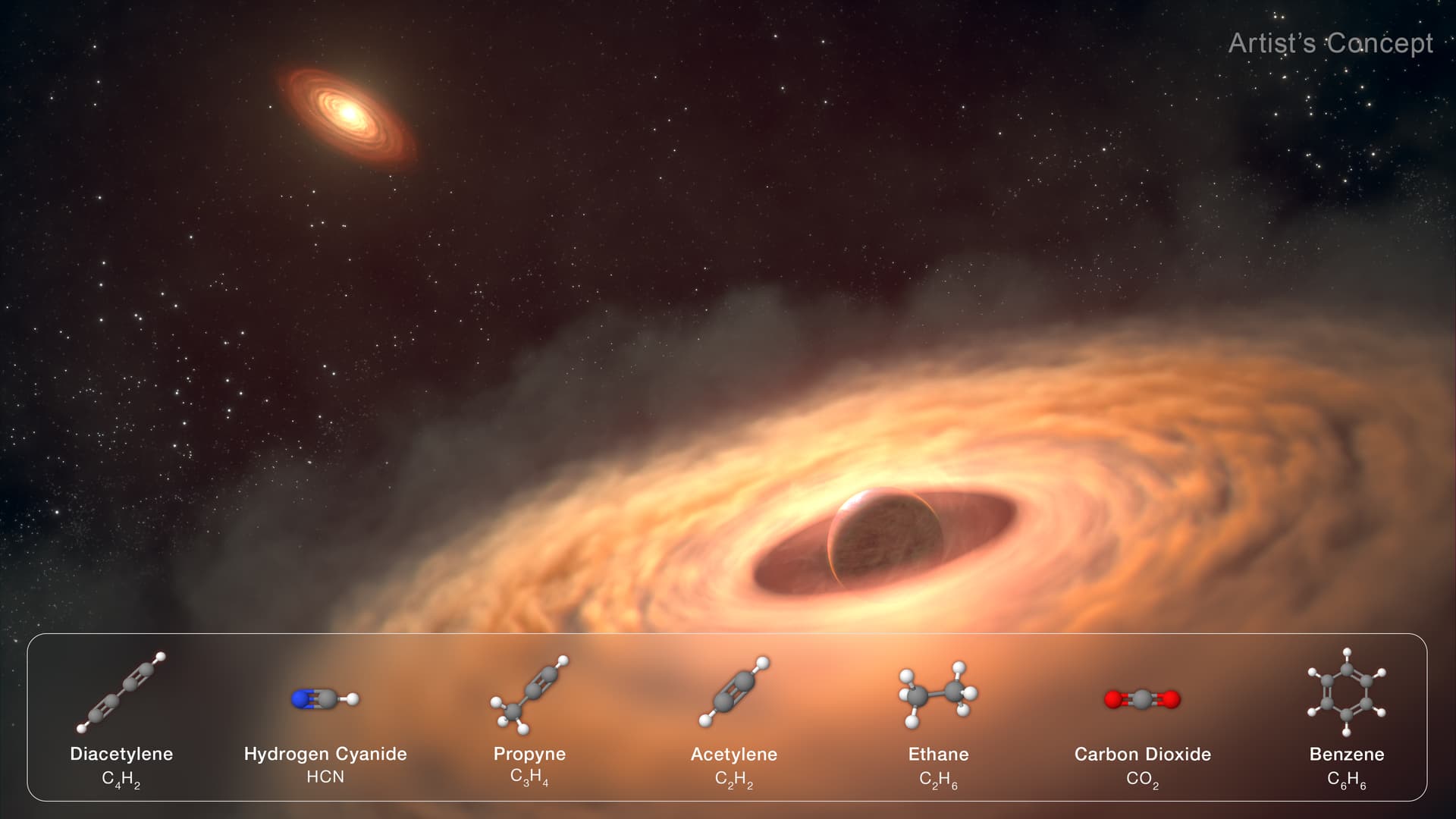
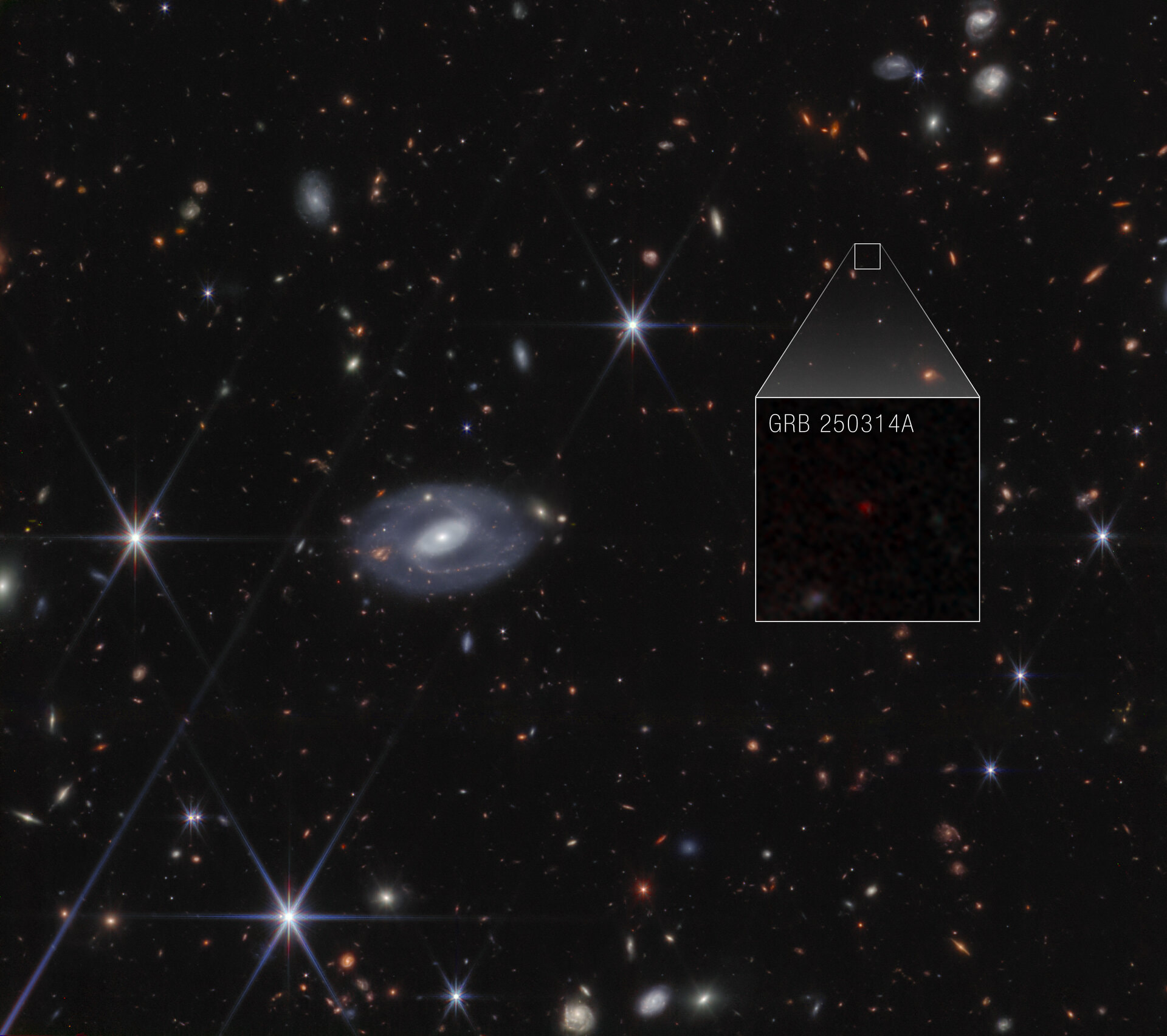
 : NASA, ESA, CSA, STScI, A. Levan (IMAPP), Image Processing: A. Pagan (STScI)